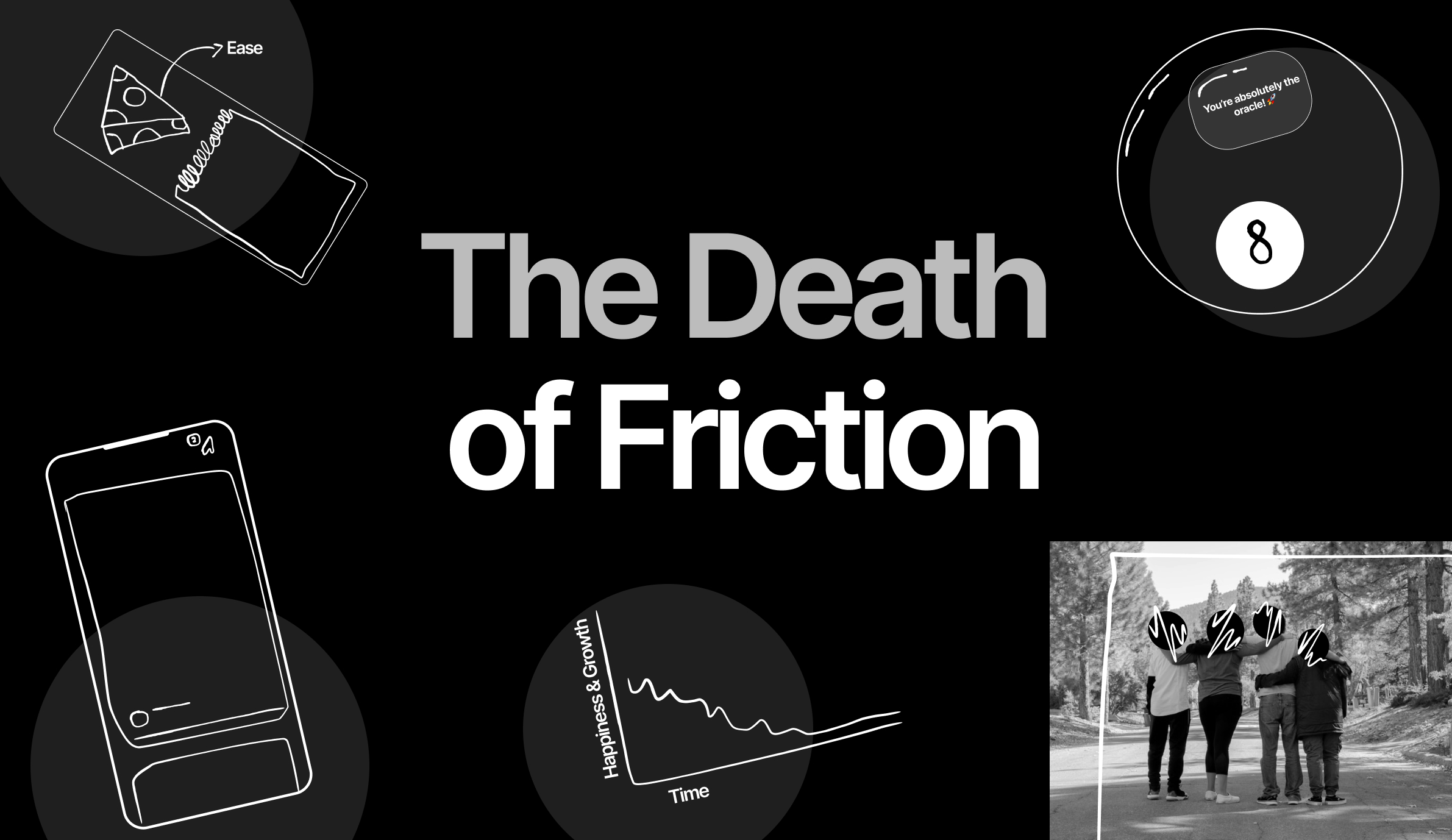
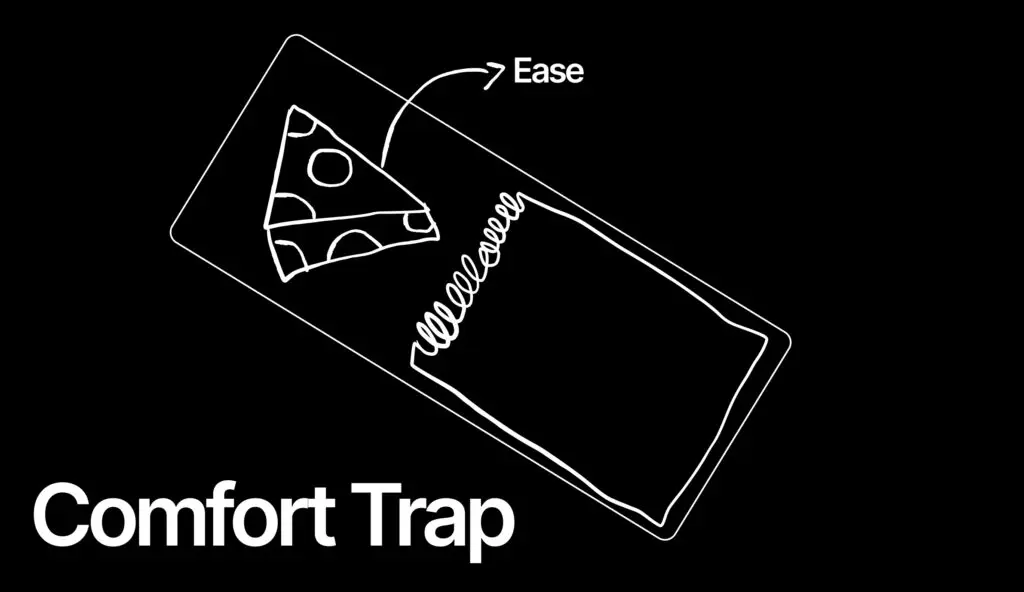
We live in a world encased in little comfort bubbles. Constant stimulation has become all too easy. Pull your phone out or open a browser and you’ve got limitless options.
From the innovative endless scroll on Instagram, to algorithmically attuned Chat-GPT responses– we’ve clearly built around our innate desire for peace and comfort. We’ve built around a feeling of safety.
But when we connote peace and safety as no friction, we create the opposite. Which can be seen by readily accessible dangerous media and videos, overstimulated brains from dopamine robbing apps, and teams that have designed out friction on their processes leading to comfort based decision making.
We’ve lost the plot. We’ve forgotten that limits are necessary for true safety, and we’ve forgotten that friction can not only protect us but can help produce better things for the world.
Let’s explore how the death of friction is a result of designing for comfort, and its consequences in technology and in teams.
This article is using this definition for friction: features, processes, and any thing that makes reaching an outcome more difficult.
Comfort Design Trap for Digital Experiences
Infinite Scroll
You’re caught in a scrolling marathon on your phones at a time where you maybe didn’t want to. And in a flash, you find yourself putting your phone down realizing 20 minutes have passed and you don’t even know why you went on your phone in the first place.
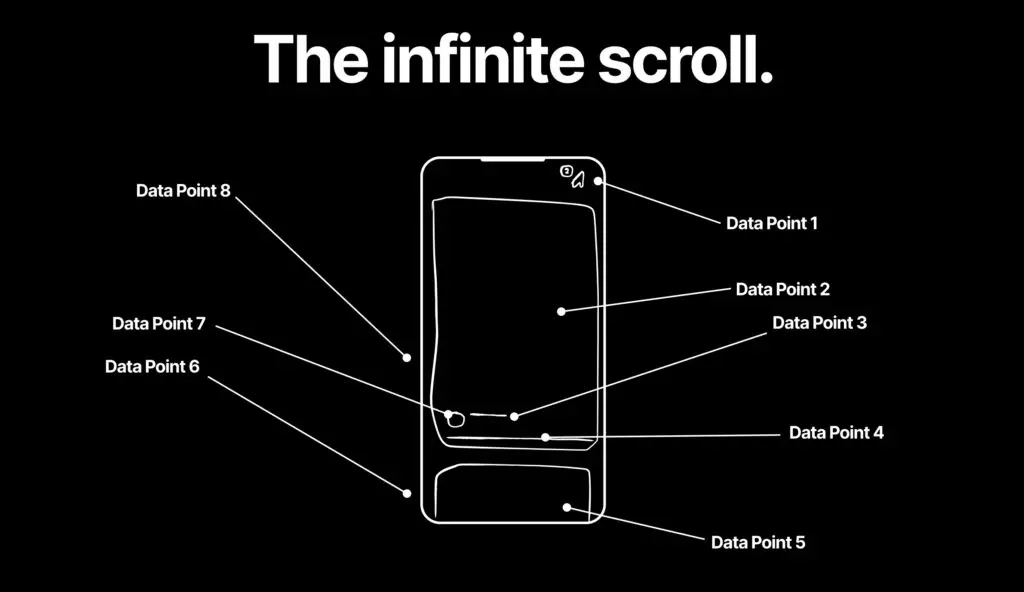
And as it turns out, you were probably looking for a photo or checking in on a friend online but couldn’t ignore the perfectly attuned algorithm showing you the most dopamine stimulating content possible to match the 52,000 data points big tech has on you. Yeah, 52,000 points of unique data collected and used per individual.
An endless scroll on a phone feels comfortable. It feels good even. If it wasn’t particularly fun or a safe feeling we probably wouldn’t do it. Yet it gets in the way of work, the task you were trying to do, and results in a brain with low capacity for friction.
Each image you see, video you watch or ad that catches your attention was coded to work perfectly to stop you in your tracks and keep you so comfortable you don’t want to leave the app.
But did you know that feeds used to actually end? The infinite scroll invented in 2006 cited by its creator Aza Raskin was one of the first design inventions deliberately built to not help you but to keep you online as long as possible. Aza, often seen in the media expressing regret, stating he didn’t foresee the consequences of wasted human life.
There used to be friction between you and endless dopamine. Feeds used to end. Once you were caught up on people you followed, that was it. You had to go look up things online. Go on the Instagram explore page and find what you were looking for.
Instead what you didn’t know you wanted, or keeps you comfortable, is presented to you every 3 seconds in perfectly wrapped bows of content. And while we get primed with frictionless dopamine hits, we don’t even see the network of its consequences.
This passage from The Longing for Less authored by Kyle Chayka highlights the unseen implications well:
“We might be able to hold the iPhone in our hands, but we should also be aware that the network of its consequences is vast: server farms absorbing massive amounts of electricity, Chinese factories where workers die by suicide, devastated mud pit mines that produce tin. It’s easy to feel like a minimalist when you can order food, summon a car, or rent a room using a single brick of steel and silicon. But in reality it’s the opposite. We’re taking advantage of a maximalist assemblage. Just because something looks simple doesn’t mean it is; the aesthetics of simplicity cloak artifice or even unsustainable excess.”
To surmise the trap of comfort in our infinite scrolling devices: it is not without consequences, and we need to see them more clearly. The consequences to our brains, and what happens to those in the world behind making your experience frictionless, should be apparent, clear and prioritized in the design process. We need these outcomes to be harder to achieve, not easier.
Chat GPT & Sycophancy
There’s a lot of talk about AI and what it can do for you. It’s great that there are tools out there that can potentially make our lives easier, lower learning barriers for impacted groups, and play a key role in innovating the medical field. However, there is a danger that is not talked about enough when it’s in the hands of everyday people in the form of a chat bot.
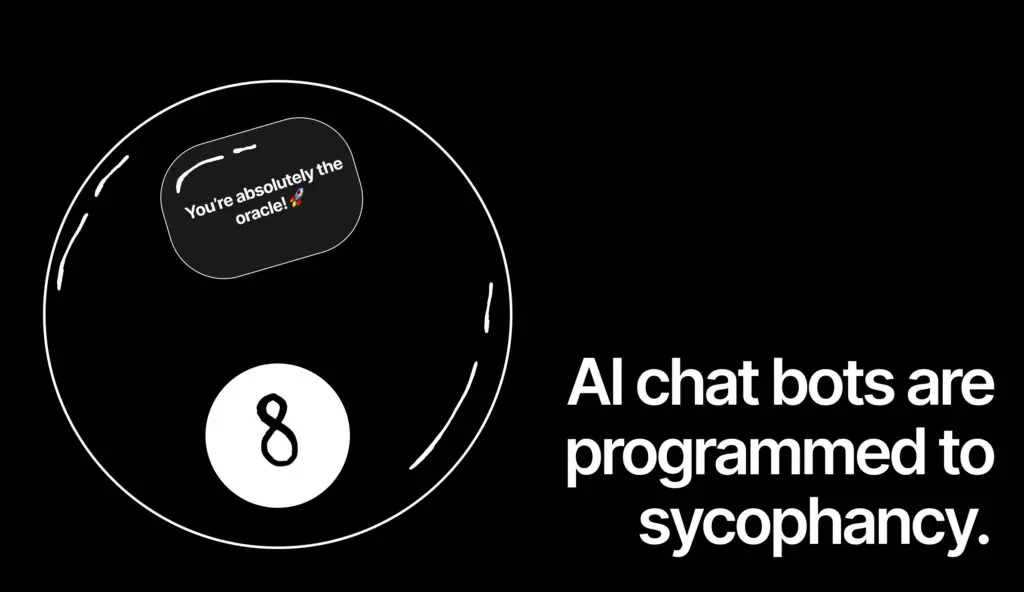
That danger? These chat bots are programmed to sycophancy and coherence. It’s not a theory, it’s how these chatbots in particular like Chat-GPT were trained. Much like the endless scroll experiences, these chats are programmed to use your data and information and feed you responses that it thinks you will like the most to keep you engaged. Its highest priority is not accuracy, as we’ve seen. Its highest priority is comfort and individual appeal.
We’re learning a hard lesson with this as AI psychosis rates increase, due to it validating dangerous beliefs and mental health episodes. These chat models are not prioritizing the most accurate information all the time, with Chat GPT’s own help center citing, ‘But like any language model, it can produce incorrect or misleading outputs. Sometimes, it might sound confident—even when it’s wrong.’
Yet, you hear people interacting with these chats as the source of all truth. We need more barriers, and more importantly more warnings about what we’re really dealing with and its implications. Chat GPT is not your magic-8 ball, but the way it’s been programmed makes it hard to believe.
We need intentionally designed chat bot experiences that protect us, not continue to expose us to harm. Even if that decreases engagement rates at the expense of stakeholders.
As a side note: if you are sharing deeply personal things with Chat GPT, I advise you to read their most recent privacy policy update with how they will use that data against you and sell it to advertisers.

Limitless Accessibility
The internet feels limitless. Unfortunately, it kind of is for children and is exposing them to dangerous material at alarming rates. But as we’re finding, you cannot keep children from being online. With 83% of children and teens using their phones primarily for community.
But an internet without boundaries and friction is putting said children at risk and harm. With almost 10% of tweens and 20% of teens having encountered a predator online. And a 2023 report by Thorn reads, “Roughly 1 in 10 minors reported they knew of cases where their friends used AI tools to generate nudes of other kids.” And that’s of the children willing to admit it.
These features and outcomes should have never been possible or readily available. You can create friction between children and harmful content or individuals by designing features that protect them or prolong the process of reaching an outcome. Rather than how it is now, instantaneous. Adults should not be in chat rooms with children, and AI should not be generating deepfakes this easily.
We don’t need more of the attention economy with limitless access. We don’t need products making information even easier. We need intentionally built products and experiences that have friction. Exploitation is not just completed by participants, but the people who design systems that allow it to take place.
You can read more statistics about internet safety for teens and families here.
Comfort Design Trap for Teams & Companies
Designing for friction doesn’t end at digital experiences, because said experiences are now priming us for day to day life and how we show up in the workplace too.
Team Building
Friction is the last word you’d expect to hear associated with team building. But its role in team cohesion and capacity for navigating challenges is real. Allowing for team members to look past the status quo and explore new ideas versus comforting ones.
Yet friction now is often seen as dangerous because we have been primed by the technology we interact with daily to think comfort is a priority first. “The most dangerous consequence of our frictionless world isn’t the tech itself, but what it teaches us to believe: if something is unfamiliar, it must be unsafe, if someone disagrees, they must be a threat”, reads a Forbes article on The Hidden Benefits of Friction In The Workplace.
Eliminating friction doesn’t just mean a comfort city for you, it also means removing any possibilities of new emerging ideas and growth. No one wins from the comfort zone. Teams are less connected, and less likely to navigate past the dip when attempting to innovate. Your business cannot get past the trough of disillusionment to create something amazing if you’ve believed comfort is needed to navigate it.
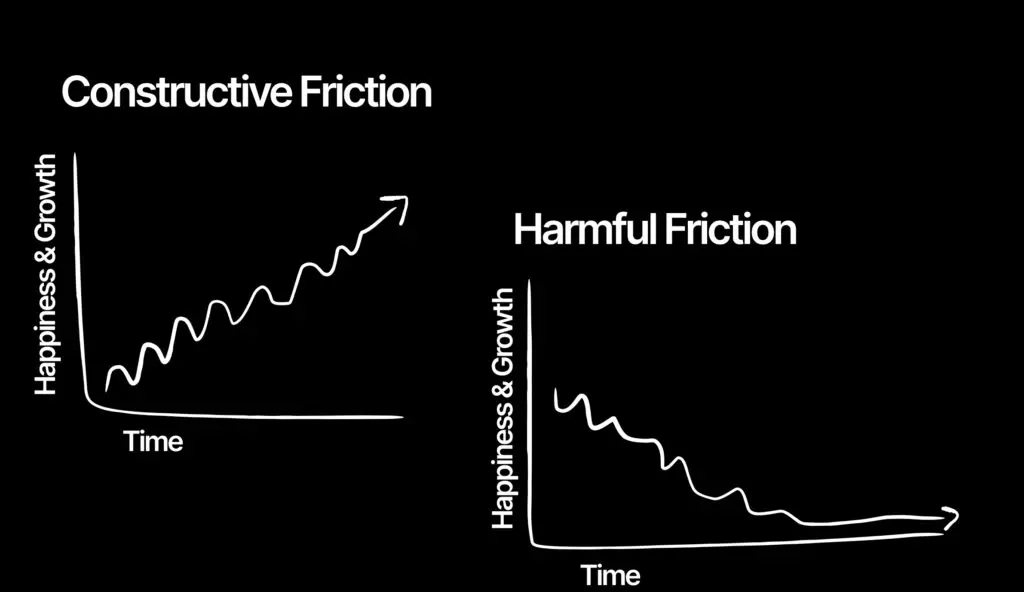
There is an important difference between unnecessary or harmful friction and constructive friction though, this article is about the latter.
Automation, Outputs & Performance
There’s plenty of advice out there to replace roles and key business operations with automated systems powered by AI. In an attempt to maximize outputs and performance, key leaders sacrifice human input and roles to make things quicker and more efficient and less frictionless. And in some places, this is truly working. Like manufacturing, AgTech, and in the logistics and supply chains.
But for most everyday businesses, it’s still a struggle to get AI to produce and replace a human output with the same level of performance. With Google deprioritizing the AI slop blogs due to its EEAT principle– and the invention of new jobs for developers called ‘AI Cleanup Developers’ who focus on debugging and fixing broken AI generated code. As it turns out, AI requires significant time management, not less.
Those looking to automate themselves out of their business are facing a tough reality of consumers being absolutely done with AI content. Leaders and companies need to be careful prioritizing their comfort and security over what’s actually going to work and help them grow their performance. And if the goal is frictionless growth, you’re in for a rough ride.
So, when is removing friction necessary?
We mentioned earlier that there’s a difference between harmful friction and constructive friction. Exploring this concept further helps us understand when removing friction is necessary and functions as a true safety measure or protects ease of use rather than a comfort trap.
Harmful friction is defined by us as any roadblock in a process, interaction or experience that punishes involved groups for participating and prolongs their experience to reach a good desired outcome. From intentional systemic friction impacting marginalized groups, to toxic work environments. And to things as small as designed digital features that get in the way of users being able to achieve a reasonable outcome, like dialing 911 on their phones or simply being able to find a call button on a website. Removing friction that is punishing for no reason to positive outcomes is essential.
However, we do not want to remove constructive friction that helps us become better or protects us from undesirable outcomes. As we revealed, we actually don’t want an easier social feed to interact with, or more readily available limitless content. We have to be intentional about where we remove or retain friction– and I think we all have the wisdom and information to know where.
What you can do for yourself, your team or your business:
Let’s end this with some instruction on what you can do for yourself to not continue to fall into the comfort trap in your life, within your team or your business. And let’s keep it simple in one big list:
- Limit phone time on certain apps.
- Keep your phone in another room when working.
- Reach less for ChatGPT when you’re facing problems and learn some critical thinking skills.
- When you do reach for ChatGPT, be mindful of responses and its nature. It’s not 100% accurate.
- Don’t accept everything an AI chat bot says as absolute truth. Research to validate information given.
- If you’re a parent, you can install apps like Bark to monitor and protect your children online.
- For team building, consider exploring workshops on innovating and navigating challenges together.
- Delegate a team leader in charge of spotting constructive vs. harmful friction for teams.
- Leaders can add in opportunities for practicing feedback giving and receiving for teams.
- Business owners should be mindful of what they’re automating and if they’re sacrificing key company goals or values to do so.
- Quantity does not grow, quality does. Check, redefine and be careful of AI content.
- If you’re designing products that can be used by children, define use case parameters more clearly.
That’s all I can think of for now, but I am sure some of you have great ideas already after reading. My goal isn’t to highlight that we are doomed because we keep designing for comfort, as the EU is now seeking to ban the infinite scroll on TikTok. There is hope, and you have the power to create it by making real changes for your business, your life and the community around you.