

“If the form of an object turns out to be ‘beautiful’ it will be thanks to the logic of its construction and to the precision of the solutions found for its various components. It is ‘beautiful’ because it is just right”, authors Bruno Munari in Design as Art.
When I read this quote before bed a few weeks ago it stopped me and forced me to reflect as a designer. How often was I letting the goal of beauty supersede the goal of ultimate functionality? And, why does that happen even to very established designers?
You’ll hear it everywhere: the point of design is to solve a problem. And hopefully improve experience along the way. Yet what you see praised in design awards, on portfolios and within comment sections is the beauty of a design. When the digital landscape is focused on aesthetics, it makes a lot of sense as to why.
We should have beautiful products that work.But when the love of aesthetics champions the goal of functionality: that’s where errors begin.
Beauty is a reward of good design, not the goalpost.
Design is a method of problem solving. Creating something unique and bespoke to an end user or audience to improve their experience with products, brands, and life overall. And here’s the thing, we hardly notice good design. That’s because it simply works, so why question it. It’s only when something is broken do we notice the design of something.
Think of the push handle that is actually pulled. We don’t take note when the door works as assumed. Well designed things are functional, helpful, and hopefully sometimes beautiful. I’m not here to say that a push/pull door is beautiful, but it isn’t ugly either. And a well done push/pull door can be artfully done, and softly click into place. There’s something really nice about that in a world of dysfunctional and annoying doors.
But no matter how amazing and beautiful a door is, if it doesn’t work, it’s close to rage bait. It’s the same with all of design in general. You can make something look insanely beautiful and breathtaking but if the intended audience doesn’t get it then it falls off the map. In the same way there is no amount of painting a puzzle piece to look like it fits in with the surrounding pieces if the jagged ends simply don’t fit.
To design well is to function well. Part of functionality is indeed contextual beauty, as it attracts use, but it has to work first. Unfortunately now, something working as intended isn’t really enough cause for celebration. Which brings sense to see design awards focusing on categories like best web design and it’s a crazy artful scroll stealing experience. An experience that is also frustrating to have if you’re looking for something on the website and your scroll keeps getting hijacked. If award shows focused on what worked, we’d probably have a lot more standard websites and brands and experiences, but what’s the fun in that?
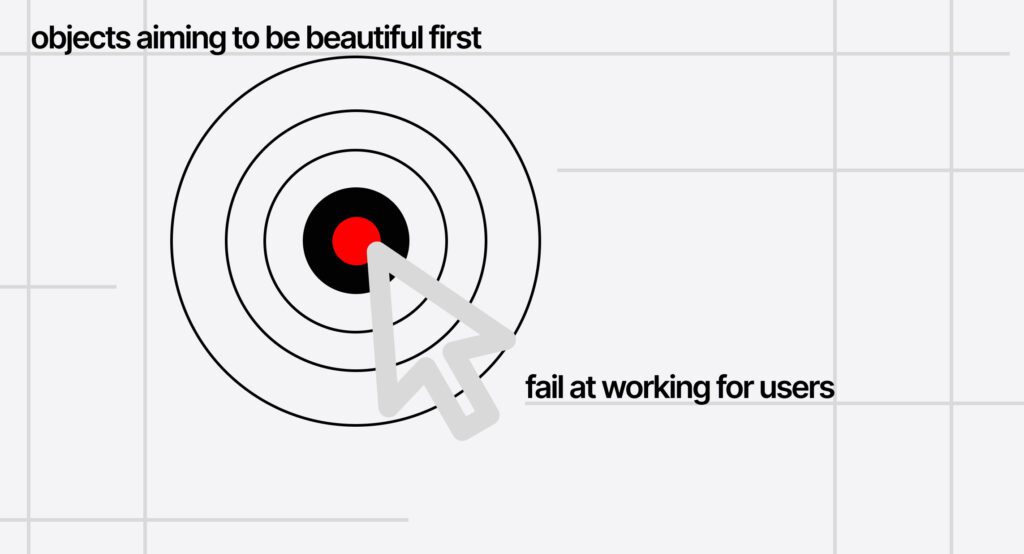
Objects that aim to be beautiful first are often exceedingly frustrating to interact with.
I do love a unique experience. I love when a website makes me question or when a product causes me to think ‘huh?!’ because I am a designer. I understand how things are made, because I make them too. But users and audiences don’t. They only interact with the surface.
When something appears enticing and rewarding and beautiful but after further interaction it hardly works and is hard to understand, users are angrier than if the experience was average and the interface was meh. The less functional something is the more frustrating it is to interact with.
When you are designing with the goalpost of beauty, you sacrifice a lot. The end result is you are constantly changing context with the wind because beauty is contextual and cultural. You never land on functionality because you chase something that is often undefined (beauty) and up to the person who ends up using or judging the product. Users and audiences need stability and functionality first before they need artful experiences baked into their everyday lives.
How should we think about beauty in design then?
Well I don’t have a perfect answer, but I have one from a book that helped me understand a solution. Aim toward creating things of a form (beauty/aesthetic) that is consistent with how the product is used. Which fundamentally is pretty basic design 101. But a good reminder in today’s day and age.
“An object should now be judged by whether it has a form consistent with its use, whether the material fits the construction and costs, whether the individual parts are logically fitted together. It is therefore a question of coherence” writes Bruno Munari.
And he continues to expand on the frustrating element of trying to make things beautiful first: that it fades quickly as the measurement of beauty adapts to the times.
“If you want to know something else about beauty…look at a history of art. You will see that every age has had its idea Venus and that all these (Venuses) it together and compared out of context of their periods are nothing less than a family of monsters”
Try your best to design functional things. And do your best to make sure the form is consistent with how any product or experience is used. Don’t sweat the rest. Feel rewarded when the user loves the experience, not just the look. Because functional things are beautiful.